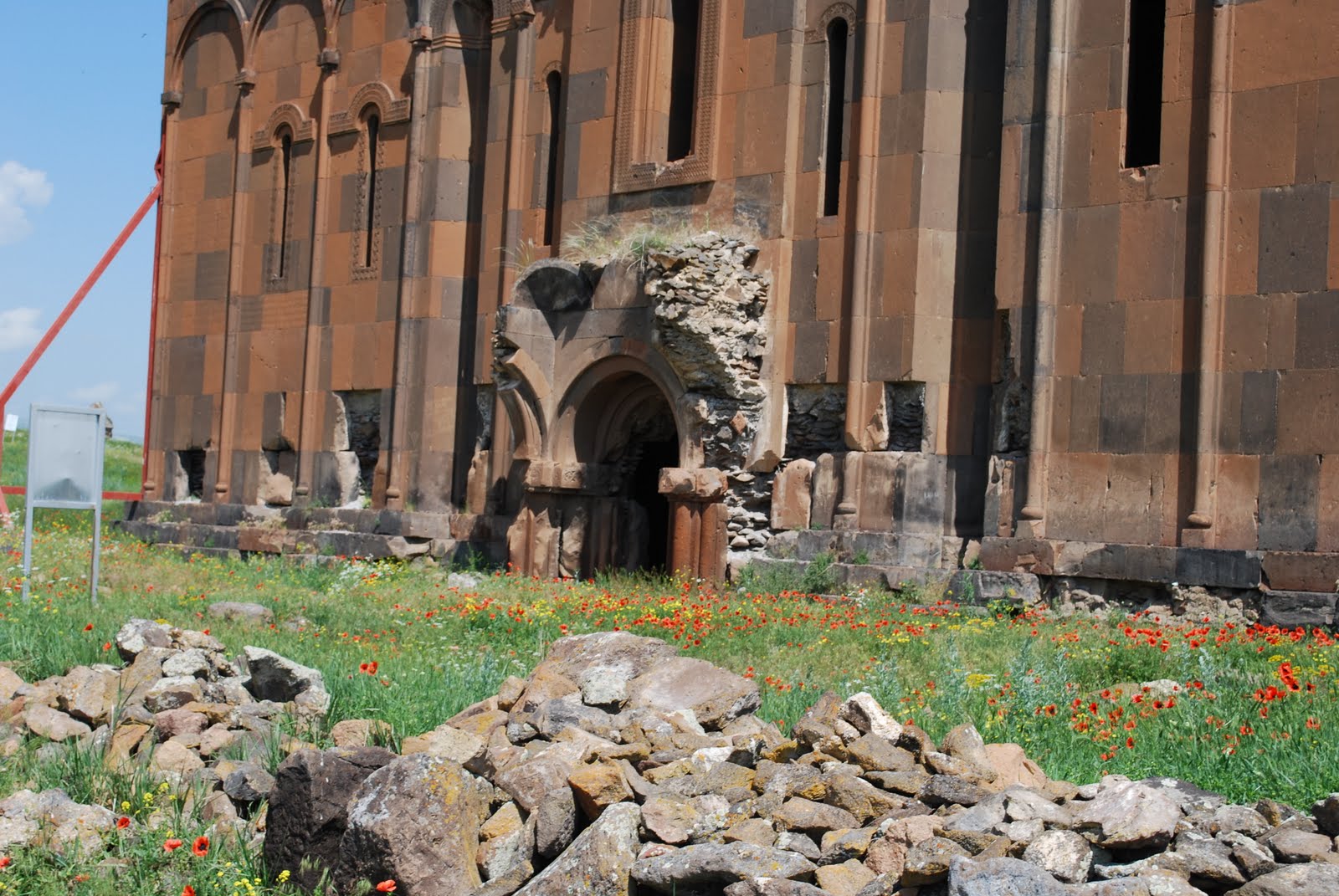
It probably was a church before but was used as a caravansary later. This was part of the silk road and camels loaded with stuff probably from China would stop here to rest. Ella Maillart in her book 'Forbidden journey', a trip she undertook across China into India with Peter Fleming (Ian Fleming's brother) wrote about the interminable boredom of riding on a horse across the Gobi desert. I can't imagine these traders riding on camels for months on end on the silk road.
Let's get moving here, boys. ....
While we did stick to the paths, sometimes there was none and we just track across these flowers. Ari would say, 'there's no path'. Yes, Ari, there is no path and that is why we need to blaze our own trail! Good thing we didn't come across any snakes. They say if you get bitten, be sure to get a good description of the snake because venom is snake specific. Better yet, kill the snake and bring it with you to the hospital... that is if you don't die first.
The black and brown stones again, very typical Armenian style.
There is definitely remnants of old Armenian ecclesiastical carvings. Armenians are master stone carvers.
I feel incredibly nostalgic looking at these pictures again. It was such a beautiful visit to a very nostalgic and beautiful place, a place that was once Western Armenia.
Thursday, August 18, 2011
Wednesday, August 17, 2011
The convent of the Virgins
It's at the bottom of the ravine, very close to the river and I remember the sign said, we couldn't get any closer because of the close proximity with the border with Armenia. Ani used to be Western Armenia and in its hey day, there was a bridge linking the two sides. Now all that is left of the bridge are little stubs of stone. At one end there is also a castle and this is closed to the public, it overlooks Armenia. The Turkish bank of the river is stoutly fenced and probably mined as well, as the guide book said.
Tuesday, August 16, 2011
The old silk road
It used to pass through here and that was why Armenia blossomed. I'm leaving for Beijing, Dunhuang and Urumqi next month, a sort of part of the silk road itinerary. Eventually I want to link China with Turkey which means all the cities and towns between them. It means Tashkent, Samarkand, Bhokara and everything else. I can't remember how many times I've read Ella Maillart's 'Turkestan solo'. I can't remember how many times I've read Sven Hedin's books, they are keeping the flames alive in me.
Monday, August 15, 2011
The shops
On the way to the mosque we passed these structures, supposedly they were the shops. Nothing is left, just the stone outlines and the wild flowers completely took over.Wow, what a glorious place and what a glorious day it was.
Sunday, August 14, 2011
The mosque
Here we are heading towards the mosque, the only building with the skinny minaret. However this minaret is different, it is square tower.
Inside are the honeycombed structures. The brown and black building blocks is very Armenian. This is the Menucehir Camii billed as the earliest Selcuk mosque in Anatolia. We didn't spend much time here though there were more Turkish visitors visiting it.
Saturday, August 13, 2011
The cathedral
It is barely holding together, there are metal struts all over to keep it from falling down and falling over. It is huge, beautiful and impressive.
Built between 989 and 1010, its architect is the one, Trdat Mendet, an Armenian who was instrumental in the restoration of the earthquake damaged dome of the Aya Sofya in Constantinople. He would go on to build other churches in the area. The guide book mentioned that a replica of this cathedral is being built on the Armenian side, clearly visible from Ani. Imagine the old cathedral in Ani and across the border on the other side a new cathedral, a replica of the old. How great is that!
Friday, August 12, 2011
The boundary walls of Ani
The vast boundary walls of Ani dates to the late tenth century, has numerous watch towers. In June this place is so beautiful that it does not look or feel as dreary as it does during the Fall/Winter months. The only way to get around in the Eastern part of Turkey is by long distance buses, each place is about a 4-5 hour ride. Initially the thought of sitting in a bus for over 3 hours was quite daunting but the actual ride wasn't that bad. For one thing the scenery changes and we pass little villages along the way. For another the occupants are all so interesting and friendly, the bus trips were actually enjoyable.
Thursday, August 11, 2011
Hulls of old churches in Ani
Besides the major churches that can still be visited, there are numerous ruins that are anonymous. These are unidentified or unidentifiable both nonetheless adds to the mystery of Ani. They say there was as many as one thousand churches thus some identify this place as the legendary 'thousand and one churches'. The honor really goes to another place in Turkey.
Subscribe to:
Posts (Atom)